 ChefBook
You have a recipe for four and you are cooking for six. Or for two. Or for a party of twenty. Here is how to change the quantities in a way that still produces the dish the recipe was written for.
Step 1: find the scaling factor
The scaling factor is the number you multiply every ingredient by:
scaling factor = servings you want ÷ servings in the recipe
- Recipe serves 4, you want 6: 6 ÷ 4 = 1.5
- Recipe serves 4, you want 2: 2 ÷ 4 = 0.5
- Recipe serves 6, you want 10: 10 ÷ 6 = 1.67
Multiply every ingredient by that number. 400 g of pasta × 1.5 = 600 g. 2 cloves of garlic × 1.5 = 3.
If the recipe gives a yield instead of servings — “makes 24 cookies”, “one 9-inch cake” — use that instead: you want 36 cookies, so 36 ÷ 24 = 1.5.
Step 2: convert awkward volumes to weight
Scaling cups and spoons produces numbers nobody can measure: 1.67 × ¾ cup is 1.25 cups, which is fine, but 1.67 × ⅓ cup is 0.56 cups, which is not.
Weights scale cleanly. If the recipe gives grams, use them. If it gives cups, convert the main ingredients to grams first — King Arthur Baking’s ingredient weight chart lists 120 g per cup of all-purpose flour and 198 g per cup of granulated sugar — then scale the grams. A kitchen scale is the single best tool for scaling recipes.
For small amounts, these are worth knowing:
| Volume | Equals |
|---|---|
| 1 tablespoon | 3 teaspoons |
| ¼ cup | 4 tablespoons |
| ⅓ cup | 5 tablespoons + 1 teaspoon |
| ½ cup | 8 tablespoons |
| 1 cup | 16 tablespoons |
So half of ⅓ cup is 2 tablespoons + 2 teaspoons, and one and a half times ¼ cup is 6 tablespoons.
Step 3: the egg problem
Halving a recipe with 3 eggs means 1½ eggs. Doubling a recipe with 1 egg is easy; scaling by 1.5 one with 3 eggs gives 4½.
The fix: beat the eggs, then measure by weight. A large egg without its shell weighs about 50 g, so:
- 1½ eggs ≈ 75 g of beaten egg
- ½ egg ≈ 25 g (or about 2 tablespoons)
Beat one egg, weigh out what you need, and use the rest for scrambled eggs or an egg wash. In savoury cooking — a frittata, meatballs — rounding to the nearest whole egg is usually fine. In baking, weigh it.
Step 4: the four things that don’t scale in a straight line
Salt, spices and strong flavours
Multiplying salt, chilli, garlic, and strong spices by the full factor can overshoot, especially when you scale up a lot, partly because less liquid evaporates from a deeper pot. A common approach is to add about three-quarters of the scaled amount, taste near the end, and add the rest if it needs it. You can always add salt; you cannot take it out.
Baking soda and baking powder
For doubling or halving a cake or batch of muffins, scaling leaveners straight usually works. For big jumps — tripling a cake, say — the batter is going into a bigger or deeper pan and behaves differently. Bakers often prefer making two separate batches over one giant one.
Pan size
A recipe’s batter is designed for a certain depth. Scale the batter without scaling the pan and it will be too deep (raw middle, burnt edges) or too shallow (dry and overbaked). Match the pan’s area to the scaling factor:
| Pan | Approximate area |
|---|---|
| 8 × 8 in square | 64 sq in |
| 9 in round | 64 sq in |
| 9 × 9 in square | 81 sq in |
| 9 × 13 in rectangle | 117 sq in |
So a recipe for an 8-inch square doubled (128 sq in) fits a 9 × 13 pan reasonably well — slightly deeper, so check it a little later than the original time.
Cooking time
Time does not scale with quantity. Twice as much stew does not take twice as long; a cake in a bigger pan takes longer, but not proportionally. Cook to the doneness signs in the recipe — a skewer that comes out clean, an internal temperature, the meat that falls apart — and start checking at the original time.
Scaling a recipe automatically
Doing this by hand for a whole recipe is fiddly, and doing it again when the guest count changes is worse.
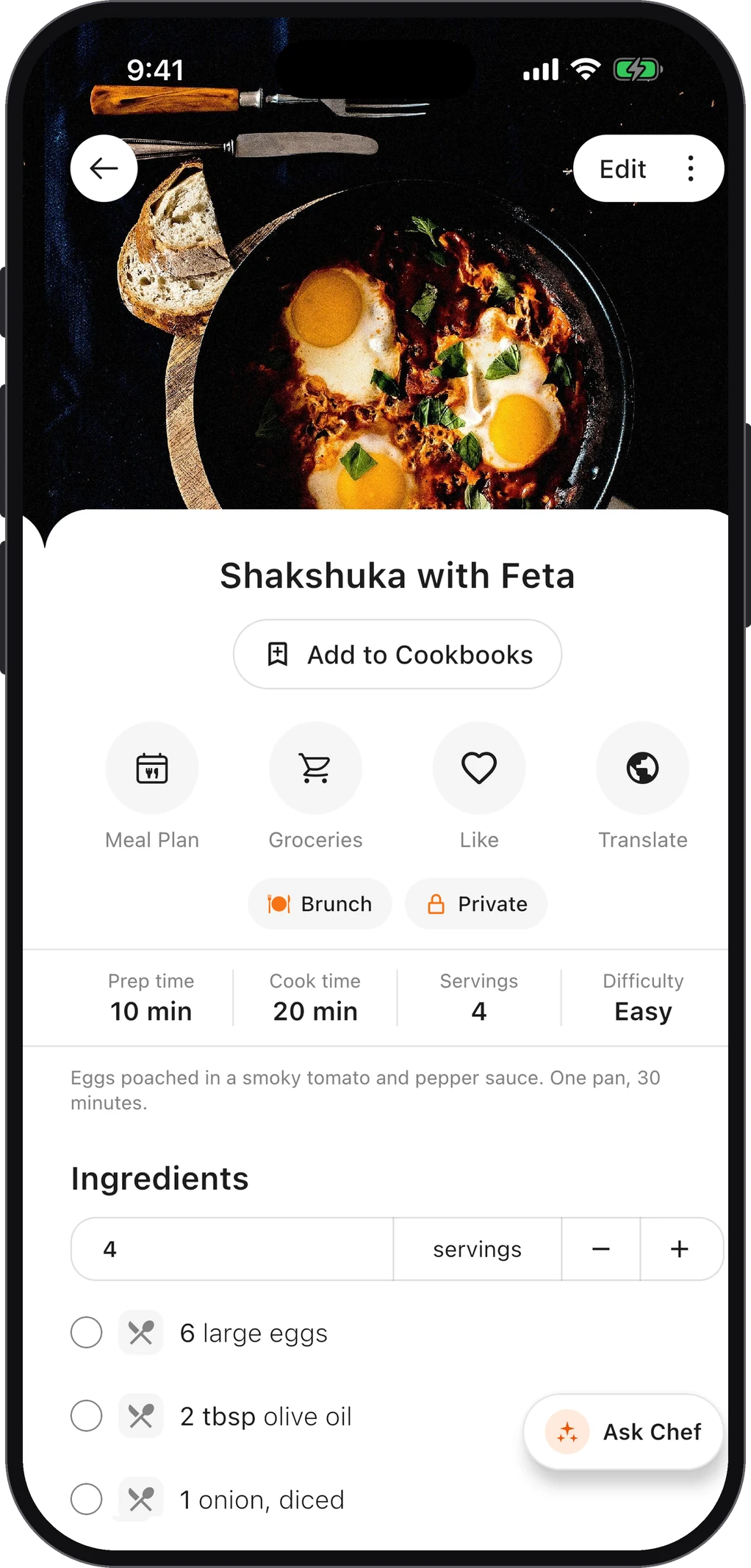
Public recipe pages on chefbook.net have a servings control: change the number of servings and the ingredient quantities are recalculated on the page, in your browser. It handles the arithmetic and the fractions; the four judgement calls above are still yours.
Once a scaled recipe is settled, the next chores are the shopping and the nutrition:
- turn the recipe into a grocery list so the scaled quantities go to the shop with you;
- work out the calories per serving — the per-serving number should not change when you scale, which is a useful check that you scaled everything.
Questions people ask
How do you halve a recipe with 3 eggs?
Beat the 3 eggs together and use half by weight — about 75 g, since a large egg without its shell is about 50 g. Or beat one egg and use half of it (about 25 g) alongside one whole egg.
Can you double a cake recipe?
Usually, if you also double the pan area (one 9 × 13 pan for a doubled 8-inch square recipe) or bake two pans. Don’t double the bake time; check from the original time onwards.
Do you double the spices when you double a recipe?
Start with less — around three-quarters of the doubled amount — and taste before serving. Salt and chilli are the ones most likely to overshoot.
How do I scale a recipe that isn’t in servings?
Use the yield instead: if it makes 24 cookies and you want 60, the factor is 60 ÷ 24 = 2.5.
Keep every recipe in one place
ChefBook is free on the App Store and Google Play — save your first recipe today.
phone camera